
Authors are kindly requested to adhere to the allocated presentation times in order to ensure the smooth running of the programme.
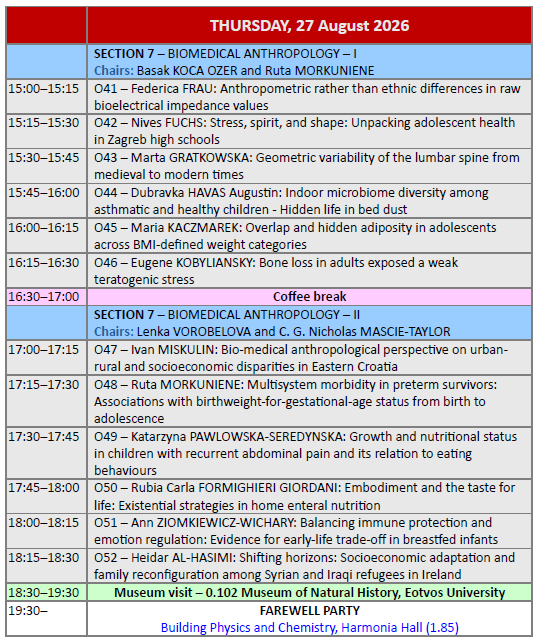
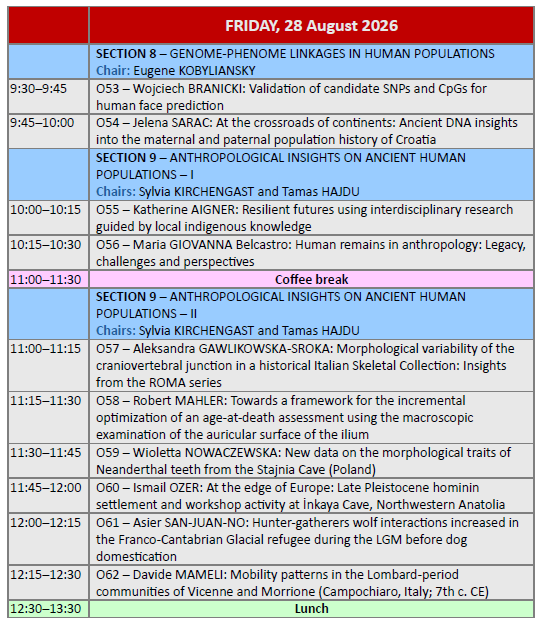
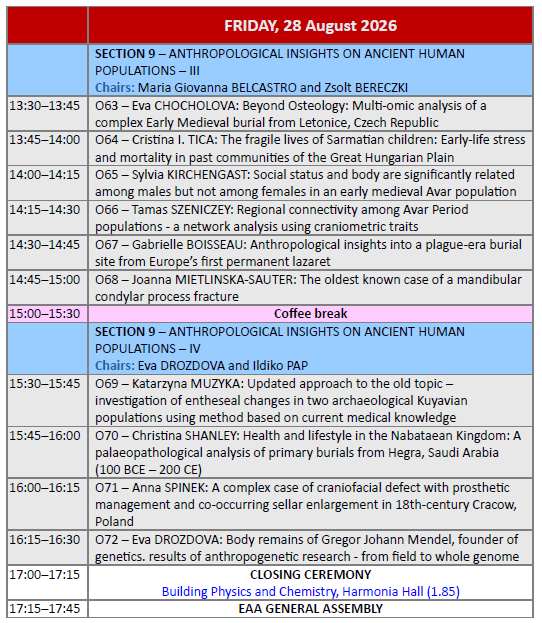
Each oral presentation is scheduled for 12 minutes, followed by 2–3 minutes for discussion and questions.
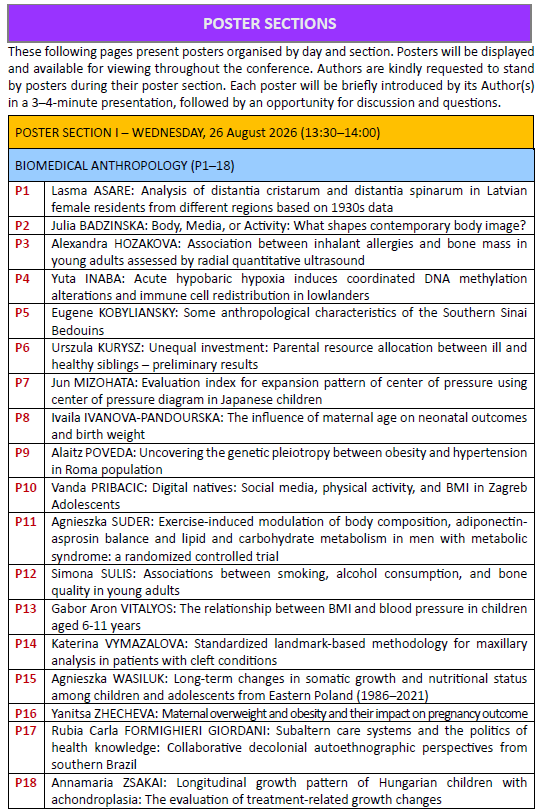
Posters will be displayed and available for viewing throughout the conference. Authors are kindly requested to stand by posters during their poster section. Each poster will be briefly introduced by its Author(s) in a 3–4-minute presentation, followed by an opportunity for discussion and questions.
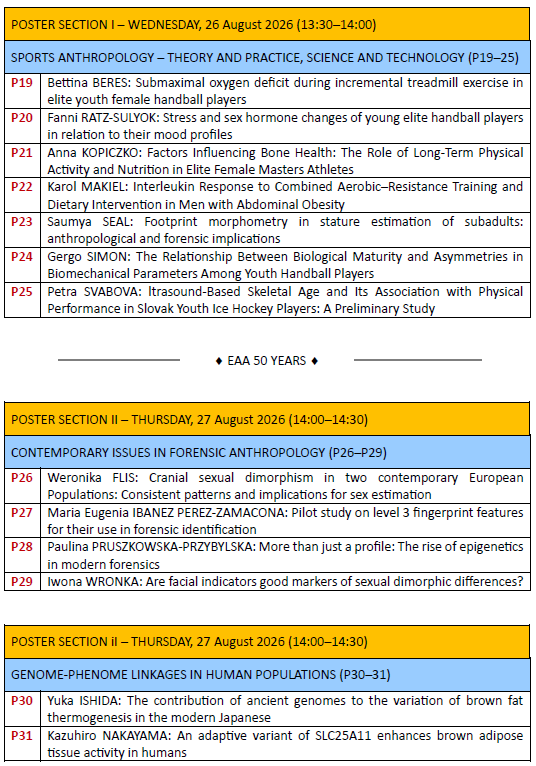
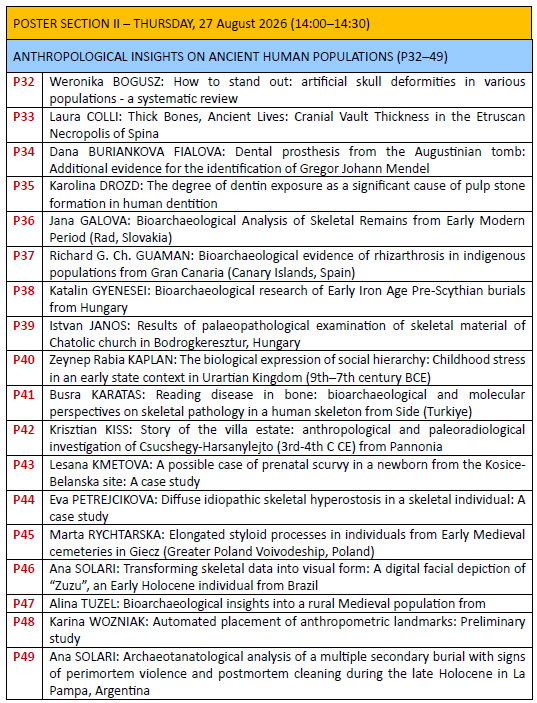
Poster section I: Biomedical anthropology; Theory and practice, science and technology,
Poster section II: Contemporary issues in forensic anthropology; Genome-phenome linkages in human populations; Anthropological insights on ancient populations
ABSTRACT BOOK is available for download here, printed copies will also be included in the conference bags.
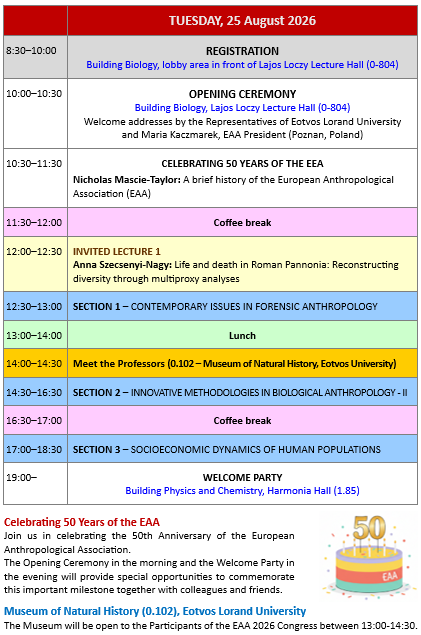
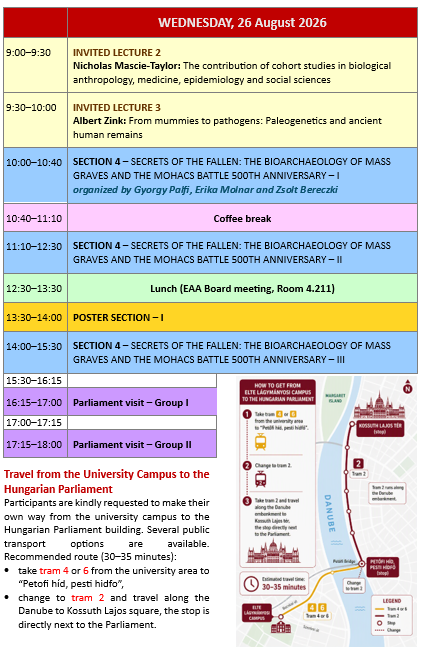
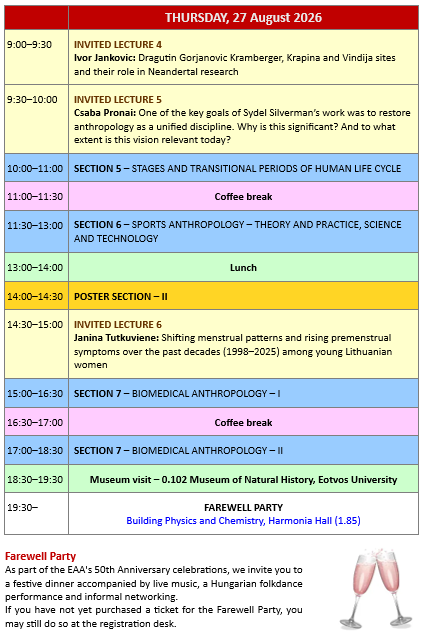
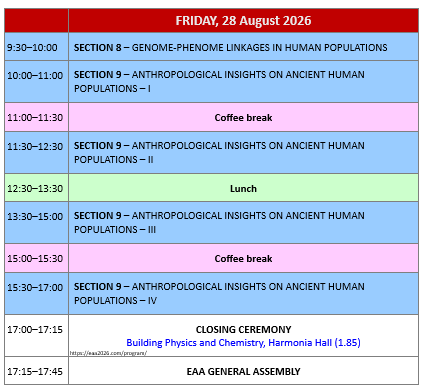
Download the detailed PROGRAMME
Surprise Social Event: Danube Dinner Cruise
As a special surprise addition to the Congress social programme, we are delighted to offer an evening Danube dinner cruise following the visit to the Hungarian Parliament.
The event is included in the registration fee and is therefore free of charge for all registered participants.
After the Parliament visit, we will take a short walk to the nearby dock (approximately 10 minutes from the Parliament building), where the boat will be waiting for us.
Detailed program
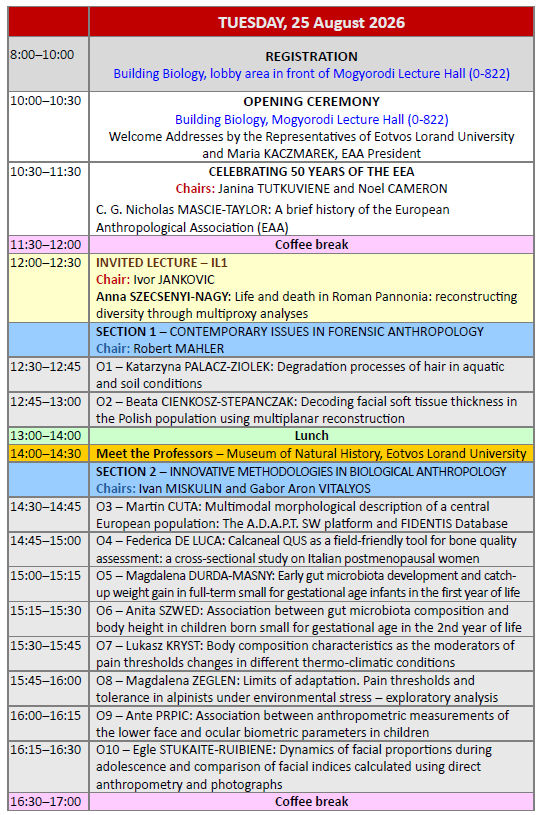
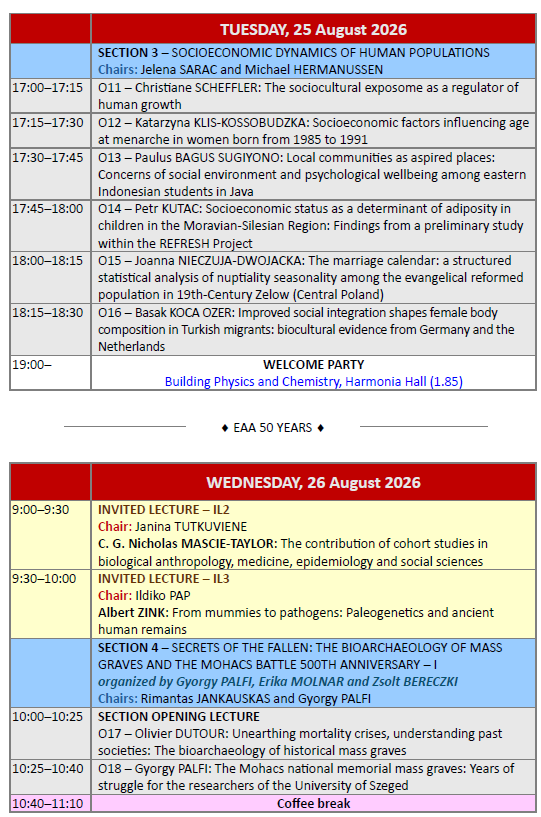
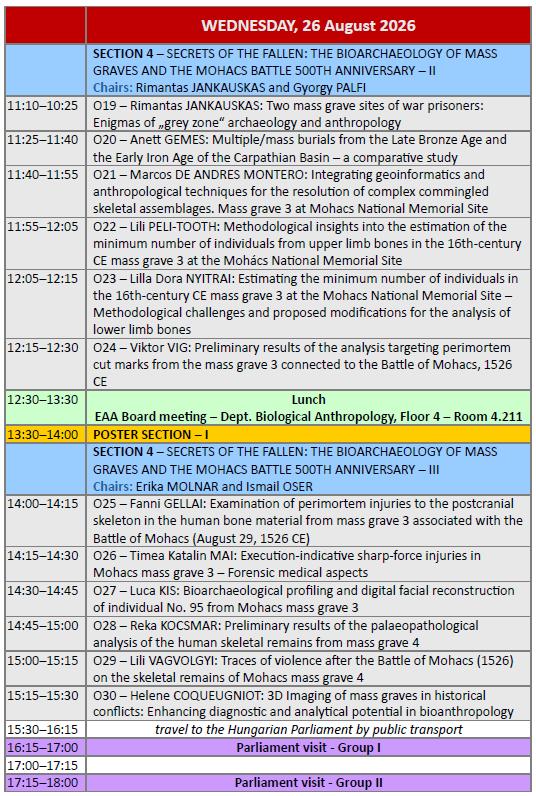
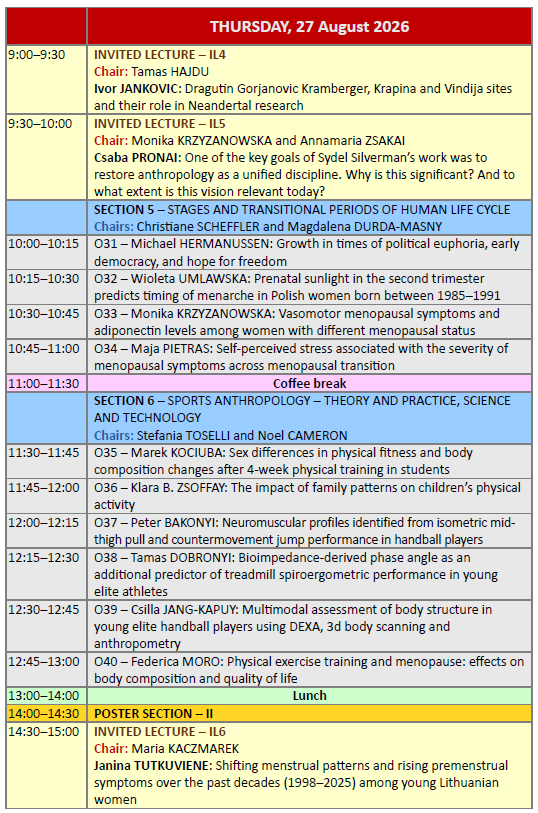
Invited lecturers
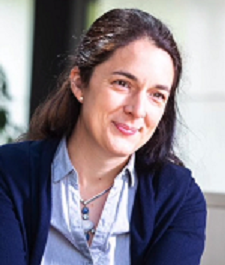
Professor Anna SzEcsEnyi-Nagy
Plenary Talk Topic: Life and death in Roman Pannonia: reconstructing diversity through multiproxy analyses
Short Biography: Anna Szecsenyi-Nagy is an archaeogeneticist, researcher, and Head of the Institute of Archaeogenomics at the ELTE Research Centre for the Humanities, a position she has held for the past five years. She completed her PhD in 2015 at the Department of Anthropology at Johannes Gutenberg University Mainz.
For the past decade, she has been working at the Research Centre for the Humanities in Budapest, in close collaboration with archaeologists, anthropologists, and historians. Her research focuses on the genetic relationships among prehistoric, ancient, and early medieval human populations across Eurasia, with particular emphasis on the Carpathian Basin.
In 2023, she established a five-year MTA–ELTE Lendulet Bioarchaeology Research Group, which investigates the biological connections, lifestyles, and cultural patterns of populations living in the Roman province of Pannonia from a comparative perspective.
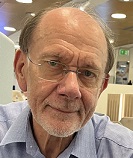
Professor Nicholas Mascie-Taylor
Plenary Talk Topic: The importance of cohort studies in medicine, epidemiology, biological anthropology and social sciences
Short Biography: Nick Mascie-Taylor is Professor of Human Biology and Health and was in the Department of Biological Anthropology, University of Cambridge for over 40 years. On retirement he was re-employed as Director of Research in Global Health in the Cambridge Institute of Public Health where he helped set up and runs a Bangladesh cohort study on non-communicable diseases. Previously he conducted a 10-year cohort study on the relationship between poverty, health and nutrition in Bangladesh and over 1 million people were moved out of extreme poverty. He is a Fellow of Churchill College, holds the higher ScD degree, has supervised over 40 PhD students, was editor of the Journal of Biosocial Science for 31 years and in 2004 was elected as an Overseas Fellow of the Hungarian National Academy of Sciences.
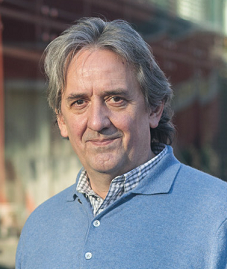
professor Albert zink
Plenary Talk Topic: From mummies to pathogens: Paleogenetics and ancient human remains
Short Biography: Albert Zink is the former Head of the EURAC Research Institute for Mummy Studies in Bolzano and is currently Director of the Bavarian State Collection for Anthropology as well as Professor at Ludwig Maximilian University of Munich.
Albert Zink is an internationally recognized authority in biological anthropology and one of the most prominent mummy researchers of our time. He is Director of the EURAC Research Institute for Mummy Studies in Bolzano and Professor at Ludwig Maximilian University of Munich. His name is closely associated with major research projects, including paleopathological and paleogenomic studies of Pharaoh Tutankhamun and his family, as well as research on the Iceman, “Ötzi.
Professor Zink was awarded an Honorary Doctorate by the University of Szeged in 2024, in recognition of his decades-long collaboration with researchers at the Department of Biological Anthropology.
Professor Ivor Jankovic
Plenary Talk Topic: Dragutin Gorjanovic Kramberger, Krapina and Vindija sites and their role in Neanderthal research
Short Biography: Ivor Jankovic is a scientific advisor at the Institute for Anthropological Research in Zagreb, Croatia, and he is an internationally recognized expert in palaeoanthropology and prehistoric archaeology. His research focuses on human evolution, Neanderthals, and the biological and cultural adaptations of Pleistocene populations, with particular emphasis on the Balkans and the eastern Adriatic region. He has led and participated in numerous international research projects, including the COST Action Integrating Neanderthal Legacy: From Past to Present (iNEAL), and has directed excavations at several important Paleolithic sites in Croatia, including Vindija Cave and Romualdova Cave.
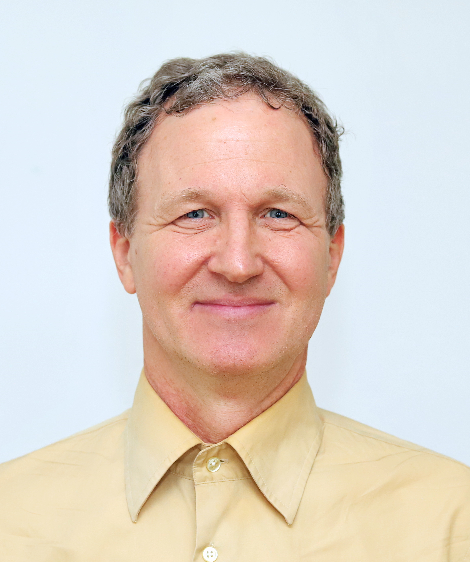
professor Csaba Pronai
Plenary Talk Topic: Sydel Silverman’s unified anthropology
Short Biography: Csaba Pronai is associate professor at Department of Cultural Anthropology of the Faculty of Social Sciences of the Eotvos Lorand University (Budapest, Hungary). He is interested in history of cultural anthropology, in visual anthropology, and in Gypsy Studies.
professor JANINA TUTKUVIENE
Plenary Talk Topic: Shifting menstrual patterns and rising premenstrual symptoms over the past decades (1998–2025) among young Lithuanian women
Short Biography: Janina Tutkuviene is a doctor, anatomist and anthropologist, Head of the Department of Anatomy, Histology and Anthropology (Institute of Biomedical Sciences, Faculty of Medicine, Vilnius University). She also heads Vilnius University’s Doctoral School of Medicine and Health Sciences. Her current research interests include child growth and maturation, growth programming, physical status in relation to various clinical pathologies, secular trends in growth and maturation, body image and attractiveness, craniofacial research. Professor has published (together with co-authors) over 200 publications (including articles and chapters at the monographies, textbooks, also popular science publications). She has given numerous scientific presentations or keynote lectures at the Universities in various European and US countries. Professor was the supervisor or consultant of 14 doctoral students and currently she supervises four doctoral theses. Janina Tutkuviene has participated in several EC projects (STOP-II, AGIS, ISEC, Leonardo da Vinci, HORIZON 2020, Alliance4Life). She is an active member of many international scientific societies: vice-president and board member of the European Anthropological Association (EAA); member of the Society for Study of Human Biology (SSHB), International Society for the Study of Human Growth and Clinical Auxology (ISGA). Janina Tutkuviene is one of the chief-editors of the journals Anthropologischer Anzeiger and HOMO, and editorial board member of Annals of Human Biology. Professor has a broad collaboration with scientists from many countries (Austria, Croatia, Germany, Latvia, Poland, Switzerland, UK, US and the others).